
Service Business Intake Workflow That Books
Build a service business intake workflow that responds fast, qualifies every lead, protects open slots, and sends crews to appointments worth running.
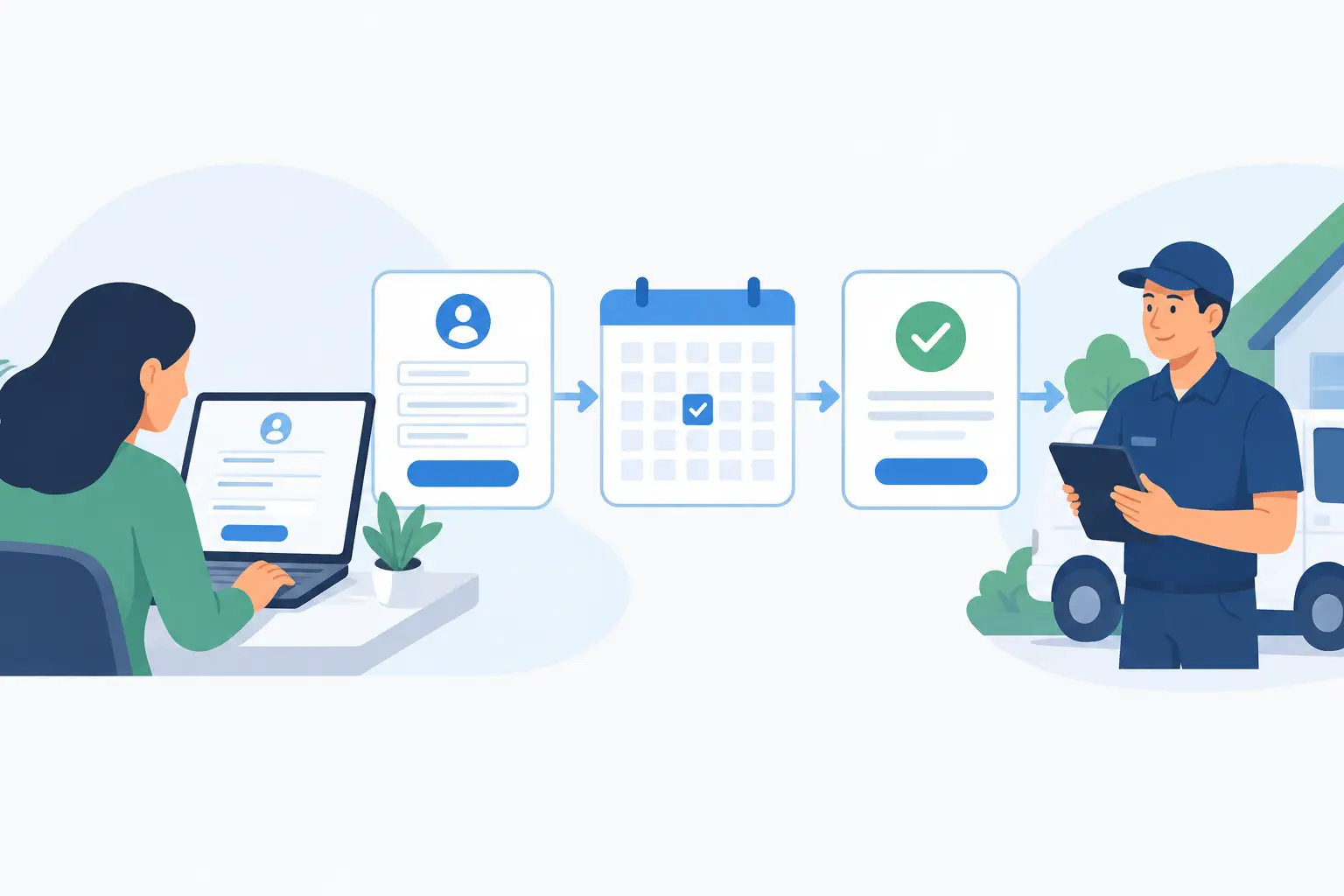
A homeowner with a flooded basement calls at 9:12 p.m. They do not want a voicemail. They want to know whether someone can help, what happens next, and whether Tuesday at 10 a.m. is actually available. A service business intake workflow decides whether that moment becomes a qualified appointment or another lead sitting unanswered until morning.
For owner-led and operations-led service companies, intake is not an administrative task. It is the first revenue operation. It determines how quickly a prospect gets a response, whether the job fits your service area and minimums, whether the calendar can support the visit, and whether your team starts the day with real work or cleanup from a backlog.
The goal is not to book every caller. The goal is to capture qualified demand quickly, protect staff time, and give dispatch a calendar it can trust.
What a Service Business Intake Workflow Must Control
A useful intake workflow is a sequence of decisions, not a collection of disconnected tools. A phone system, web form, shared inbox, calendar, and dispatcher can all be present while leads still fall through the cracks. The handoffs matter more than the individual software.
For most field-service businesses, the workflow starts at first contact and ends only when the appointment is confirmed, recorded in the right system, and ready for action. Between those points, the operation needs to control response time, qualification, availability, booking, confirmation, and escalation.
That matters because an open calendar slot is not the same as a productive appointment. A restoration company may need to verify the loss type, property location, urgency, insurance status, and service radius before dispatching. A contractor may need to confirm project type, minimum job size, homeowner status, and timeline. If those rules live only in one office manager's head, intake quality changes with every shift.
A disciplined workflow turns those rules into consistent actions. The caller is either qualified and scheduled, routed to the right person, asked for missing information, or respectfully screened out before a truck roll or sales visit is wasted.
Build the Workflow Around the First Five Minutes
The highest-risk period is usually the first few minutes after a call, text, or form submission. During business hours, a live staff member may answer. After hours, during lunch, or while the office is already handling another caller, the lead needs an immediate next step.
That does not mean every inquiry needs a long conversation. It means the business acknowledges the contact and begins collecting the information needed to decide what happens next. For a missed call, an automatic text-back can ask a direct question: “Thanks for calling. What service do you need and what is the property ZIP code?” The response opens a structured intake instead of leaving the prospect to call a competitor.
The questions should be short and trade-specific. Too many questions before any indication of help can drive away urgent callers. Too few questions produce low-quality appointments. The right balance depends on the service.
A water damage company may start with whether there is active water, the source, property type, location, and whether the caller needs immediate help. A remodeling company may start with project type, location, budget range, and desired timeline. An HVAC company may need equipment status, ZIP code, and urgency before offering the next available visit.
The workflow should also define escalation. Some calls should bypass normal scheduling entirely: an active emergency, a repeat commercial client, an existing job with a safety issue, or a caller who requests immediate human help. In those cases, the system should route to an on-call person with the context already collected. Escalation without context simply moves the intake burden from the caller to your team.
Status: Contact captured
At this point, the business should have a time-stamped record of the call or message, the caller's contact details, the source, and the first stated need. If a staff member picks up, they should see the same intake fields used after hours. That consistency is how you compare performance across shifts and channels.
Put Qualification Before the Calendar
A common failure mode is treating an appointment as the finish line. It is not. A booked appointment that falls outside your territory, does not meet your minimums, or requires a service you do not provide is an expensive calendar entry.
Qualification rules should reflect the actual economics of your operation. Start with the conditions that make a lead clearly actionable or clearly unsuitable. Service area is often first. Then consider job type, property type, urgency, customer type, budget or insurance requirements, and staffing capacity.
Keep the rules visible and reviewable. “Good lead” is not a rule. “Residential water intrusion within 35 miles, active or recent loss, property owner or authorized manager, and no excluded service type” is a rule your team can enforce.
There will be exceptions. A large commercial opportunity outside the normal radius may deserve review. A low-value repair for a long-term customer may be worth taking. The workflow should allow an authorized person to override a rule, but it should not force frontline staff to improvise on every call.
Lead scoring can help prioritize the gray area. A score is useful when it reflects your real fit criteria and drives a clear action, such as schedule, route to sales, request more details, or decline. A score without an operating decision is just another dashboard number.
Status: Qualified for scheduling
Once a prospect qualifies, collect the details dispatch needs to deliver the appointment well: service address, preferred time, problem description, access considerations, decision-maker availability, and any photos or documentation your trade requires. The booking should carry this context forward. Your field team should not arrive asking questions that intake already answered.
Connect Scheduling to Live Capacity
Scheduling is where many intake workflows break. Staff may book from a stale spreadsheet, a shared calendar that does not reflect dispatch changes, or a system that allows two people to claim the same slot.
A dependable workflow checks live availability before offering options. It should use the calendar or dispatch board your operation actually relies on, not a separate appointment list that someone must reconcile later. When a prospect selects a time, the slot should be temporarily held while the booking is completed. Then the appointment should be written to the calendar with the correct customer and job details.
The hold matters. Without it, two simultaneous conversations can be offered the same 10 a.m. arrival window. With a hold that expires after a defined period, the business can protect availability without blocking a full day for a caller who disappears.
Not every service business should expose every open slot. Emergency services may offer immediate dispatch or a narrow arrival range. High-ticket in-home estimates may reserve certain windows for qualified opportunities only. Crews with geographic routing constraints may need dispatch approval before a time is confirmed. The workflow should reflect those operational realities rather than pretending every calendar is a consumer booking page.
Status: Slot held, then confirmed
After booking, send a clear confirmation by text. Include the appointment date, time or arrival window, service address, and a simple way to reschedule or cancel. If preparation is required, state it plainly.
A day-before confirmation protects capacity again. If the customer confirms, the appointment remains active. If they need to move it, the workflow should offer eligible alternatives and update the underlying calendar. If they cancel, the slot should be released and the cancellation recorded. A silent no-show is not an unavoidable cost when the business has a process to confirm attendance.
Make the Morning Handoff Operationally Useful
By the time the office opens, the team should not be reconstructing the previous night's calls from voicemail, text threads, and handwritten notes. They should see a clean queue: appointments booked, leads awaiting review, escalations made, disqualified inquiries, cancellations, and unconfirmed visits.
Each record should answer practical questions quickly. Who contacted you? What do they need? Why did they qualify or fail to qualify? What was booked? Which staff member or automated process handled it? What source generated the lead? Did the customer confirm?
This is also where revenue attribution becomes useful. If a campaign, referral source, or call channel creates booked and completed work, you can measure it. If a source creates many contacts but mostly unqualified inquiries, you can adjust spend, messaging, or screening rules. Attribution is not just for marketing reports. It helps operations decide which demand is worth making room for.
PsPro AI is built around this full path: immediate phone and SMS response, business-specific qualification, live availability checks, calendar booking, confirmations, and dispatch-ready records. The point is not to replace your operating judgment. It is to enforce the rules your business has already decided on when no one is available to answer.
Review the Exceptions, Not Just the Booking Count
A weekly review should look beyond total appointments. A high booking rate can hide a poor-quality intake operation if crews are being sent to out-of-area jobs, price shoppers, duplicate requests, or appointments that repeatedly cancel.
Review missed calls, response times, disqualification reasons, schedule conflicts, no-shows, and escalations. Listen to recordings or read transcripts when available, especially for leads that should have been booked but were not. Look for rule gaps: a new service area, a job type that needs a different question, or a scheduling window that is causing friction.
Do not overcorrect based on one unusual call. Intake rules should protect the common path while giving your team a way to handle legitimate exceptions. The right workflow is strict where wasted capacity is predictable and flexible where human judgment adds value.
A good intake process does not promise that every lead will become revenue. It gives every qualified caller a fast, accurate path to a confirmed next step - and gives your team a calendar made of appointments worth running.