
Service Business Call Routing Guide for Faster Booking
Use this service business call routing guide to answer urgent leads, qualify demand, route exceptions, and fill real calendar openings without conflicts.
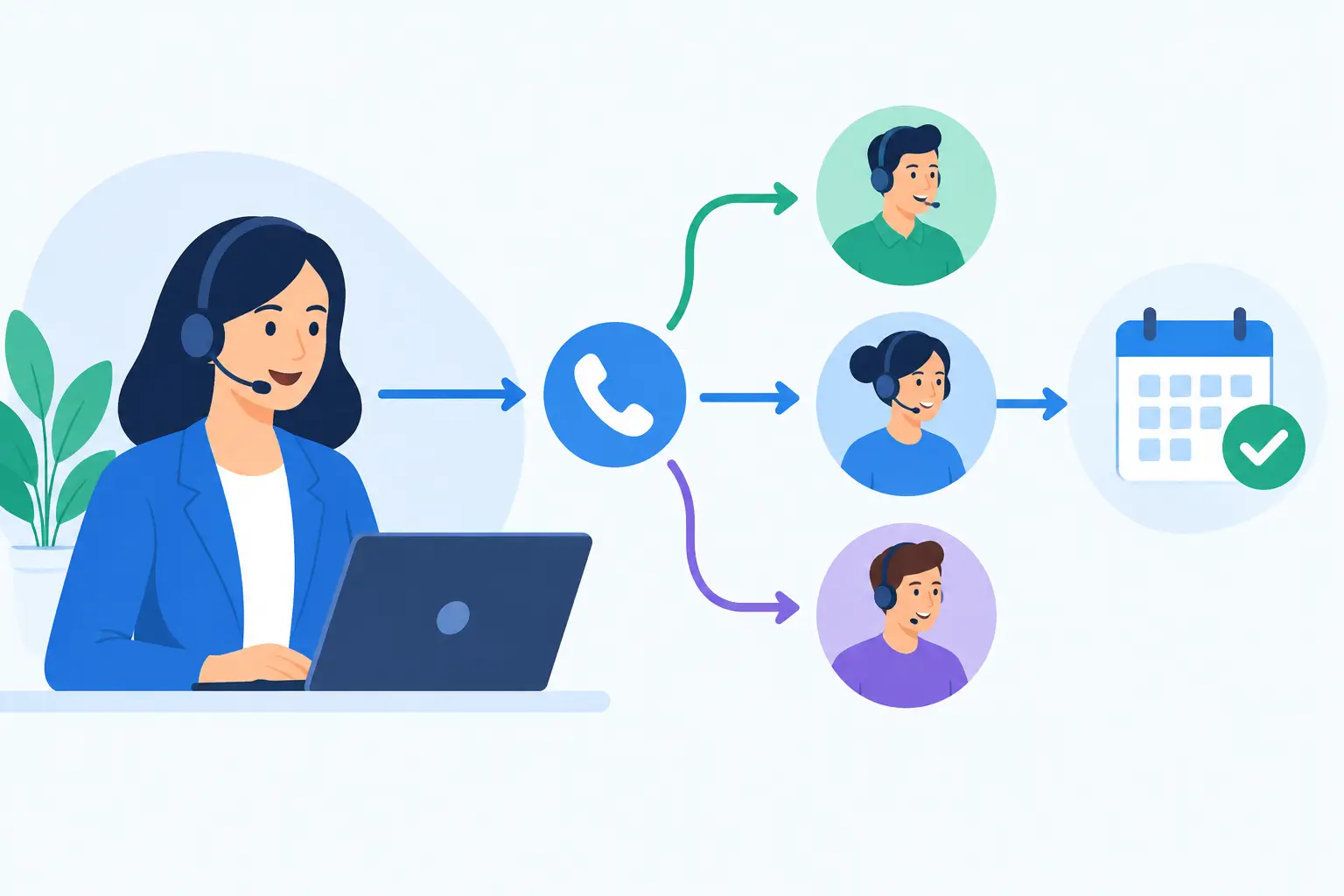
A water-damage caller at 9:14 p.m. is not looking for a menu tree. They want to know whether someone can help, how soon a crew can arrive, and whether their insurance situation is workable. If the call reaches voicemail, the lead may be gone before the office opens. This service business call routing guide explains how to build a call flow that protects urgent revenue without filling your calendar with bad-fit appointments.
Call routing is not merely deciding which phone rings. For a field-service business, it is the operating logic that determines who answers, what they need to learn, when a job gets escalated, and whether an appointment can be placed on a real schedule. Done poorly, routing creates long hold times, duplicate bookings, and unnecessary truck rolls. Done well, it turns an inbound call into a qualified, confirmed next step.
Start With the Revenue Risk, Not the Phone Tree
Most service businesses inherit their routing setup: one main number, a few extensions, an after-hours voicemail, and perhaps a forwarded cell phone. That arrangement may be adequate on a quiet Tuesday afternoon. It fails when several urgent calls arrive while the dispatcher is coordinating crews, the office is closed, or the on-call manager is already handling an active loss.
Map the calls that matter by urgency, job value, geography, and qualification requirements. A restoration company might treat an active flood, sewage backup, or fire loss differently from a request for general cleaning. A remodeling contractor may route an estimate request differently from a warranty question. The point is not to make every caller answer twenty questions. It is to separate a revenue opportunity that needs action now from one that can wait, or one that should not consume staff time at all.
Your routing design should answer four operational questions:
- What can be handled immediately without a human?
- What facts must be collected before dispatch or booking?
- Which conditions require an on-call person or manager?
- Where should each resulting record go: calendar, dispatch board, CRM, or follow-up queue?
If those answers are vague, no phone system will fix the workflow. You will simply move confusion faster.
Build Your Service Business Call Routing Rules
1. Identify the caller before choosing the destination
The first routing decision should be based on the type of caller, not the department name. New prospects, existing customers, vendors, job applicants, and wrong-number callers need different paths. Existing customers with an active job may need service support, while a new caller reporting a burst pipe may need immediate intake and escalation.
Use a short opening that establishes intent: Are you calling about a new service need, an existing appointment, or something else? From there, collect only the information that changes the next action. For an emergency trade, that may include service address, active damage, safety hazards, source status, and insurance involvement. For a scheduled estimate, it may include project type, location, budget range, property ownership, and timeline.
Qualification rules should reflect your actual operating capacity. If you do not serve a county, do not book it and hope to sort it out later. If a job requires a minimum scope to justify a dispatch, screen for that threshold before reserving a slot. A qualified opportunity is more valuable than a full calendar of calls your team cannot profitably serve.
2. Route urgent calls to an accountable escalation path
Urgent does not always mean "send every call to the owner." That approach is common, and it burns out the people responsible for making decisions. Define urgency with specific triggers, then set a clear escalation ladder.
For example, an active water loss inside your service area may trigger an on-call dispatch notification after the caller confirms the address and basic conditions. A caller reporting a non-urgent moisture concern may be offered the next available inspection slot. A request outside the service area can receive a polite decline and be recorded without interrupting a technician.
Every escalation needs a fallback. If the first on-call person does not acknowledge, who is next? How long does the system wait? Does the caller receive an expectation such as, "A coordinator will call you within 10 minutes," or is the appointment already secured? The answer depends on the trade and the job, but ambiguity should never be part of the plan.
3. Book only against live availability
A routing system that offers times from a static list creates dispatch problems before the day begins. Availability changes when jobs run long, crews are reassigned, or a customer cancels. Your booking workflow should check a live calendar or managed dispatch board before presenting a time.
When a caller selects Tuesday at 10 a.m., the system should temporarily hold that slot while the details are confirmed. Once confirmed, it writes the appointment to the calendar, sends a confirmation text, and records the job details where the dispatch team can act on them. If the slot disappears during the conversation, the caller should be offered the next valid option rather than being promised a time someone else already owns.
This is where many generic answering services fall short. Capturing a message is not the same as securing an appointment. A good call-routing workflow closes the gap between first contact and an operationally usable booking.
4. Give routine calls a controlled next step
Not every call needs live escalation. Appointment changes, basic service-area questions, invoice inquiries, and non-urgent estimates can be handled through self-service, scheduled callbacks, or a dedicated office queue. The key is to make the handoff visible and time-bound.
If a caller needs to reschedule, offer genuine openings and send the updated confirmation. If an existing customer has a billing question, route it to the appropriate queue with the account details already captured. If someone leaves information after hours, send an immediate text acknowledgment so they know the request was received and know what happens next.
A missed-call text-back is especially useful when no one can answer in time. But it should do more than say, "We missed your call." It should begin a two-way conversation that identifies the need, applies your rules, and either books, escalates, or places the inquiry in a defined follow-up process.
What Your Team Should See the Next Morning
A routing system earns trust when the office can audit what happened overnight. Your team should not be digging through voicemail recordings and disconnected text threads to reconstruct the queue.
For each inbound interaction, the record should show the caller’s contact details, source, service need, qualification answers, lead score or disposition, appointment status, escalation history, and transcript or recording where appropriate. If recording is used, provide spoken disclosure and follow the applicable rules for your locations and calls.
The morning view should make exceptions obvious: an urgent caller awaiting callback, an appointment pending confirmation, a cancellation that opened capacity, or a lead disqualified because it falls outside your territory. That lets the dispatcher act before the first crew is rolling, not after a frustrated prospect calls a competitor.
PsPro AI is built around this revenue-capture workflow: answer, qualify, check live availability, hold the slot, book it, confirm it, and route exceptions to the right person. The relevant test is not whether automation sounds impressive. It is whether your staff receives clean, actionable work instead of a larger pile of messages.
Test the Failure Points Before They Cost You
Call routing is an operating system, so test it like one. Call after hours. Call while the office is busy. Ask to reschedule. Try to book an already occupied time. Pretend to be outside the service area. Trigger an emergency condition and verify the escalation path.
Pay particular attention to edge cases. What happens when the caller hangs up after giving an address? What happens if a calendar connection fails? What if the on-call manager does not respond? A mature workflow records the event, retries important delivery steps, and gives staff a way to intervene without creating duplicate jobs.
Review results weekly for the first month, then regularly as staffing, territory, and service offerings change. Track answer speed, abandoned calls, qualified leads, booked appointments, no-shows, cancellations, and jobs attributed to inbound calls. Do not judge routing only by call volume. A lower-volume route that protects crew capacity and produces higher-quality appointments can be the better commercial outcome.
The practical goal is simple: when the right caller reaches out, your business should provide a clear next step while the opportunity is still yours. When the call is a poor fit, your team should know that before it becomes a wasted slot, a wasted drive, or another voicemail nobody had time to return.