
Restoration Answering Comparison for Emergency Calls
Use this restoration answering comparison to choose a faster, more controlled way to capture emergency losses, qualify callers, and dispatch crews at night.
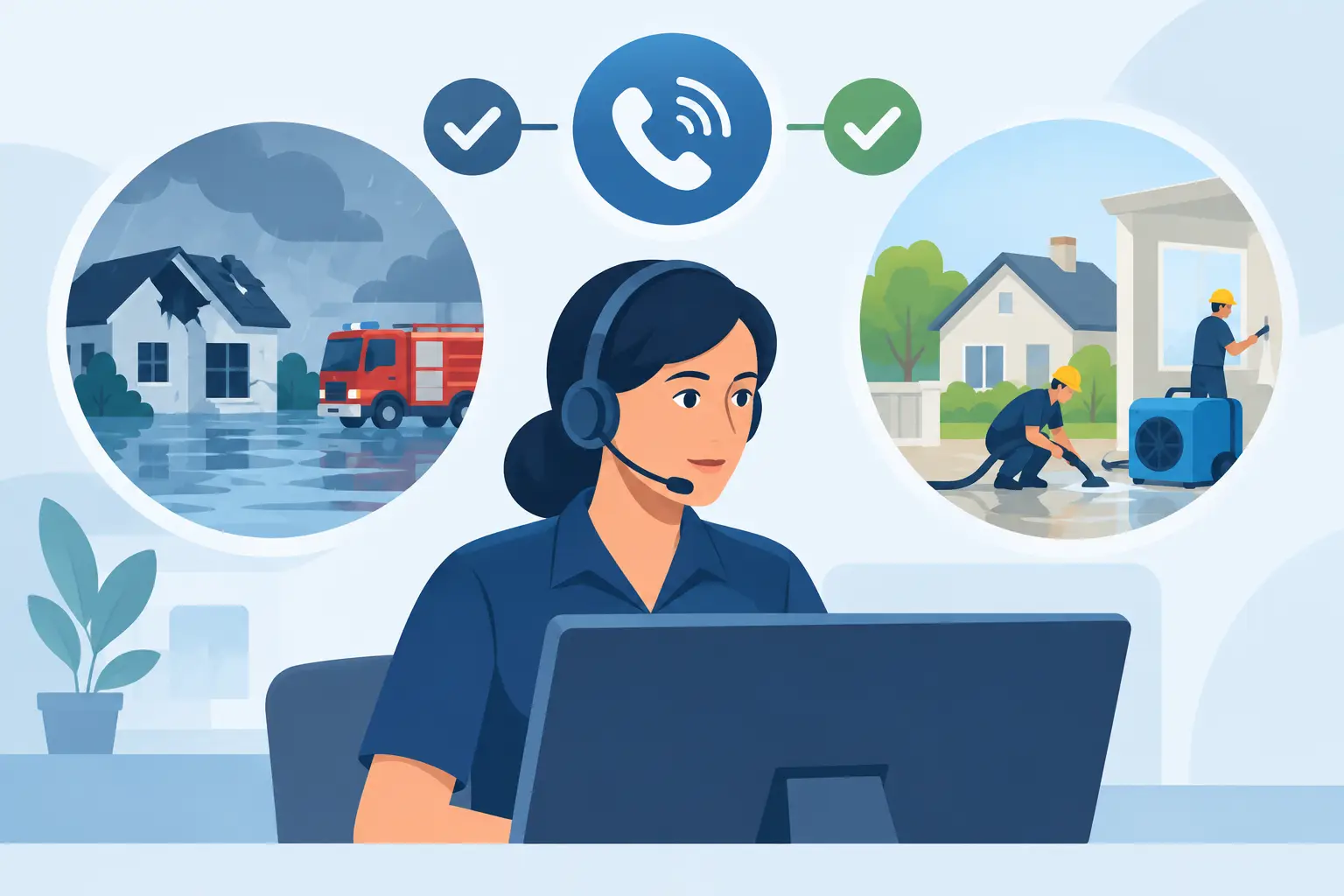
At 2:13 a.m., a homeowner with water coming through a ceiling is not comparing your certifications, truck count, or five-star reviews. They are calling the next company if nobody answers. A useful restoration answering comparison starts there: which option gets a real emergency caller to a qualified, scheduled response before the loss goes elsewhere?
For restoration operators, answering coverage is not an administrative choice. It controls revenue capture, after-hours workload, crew utilization, and customer confidence during the first minutes of a loss. The right model depends on your call volume, geography, staffing, and dispatch process. But any option should be judged by what it actually does after the phone rings.
What to Measure in a Restoration Answering Comparison
Do not compare answering options by monthly price alone. A low-cost service that takes a message can still be expensive if the caller reaches a competitor before your on-call tech returns the call.
Measure each option against four operating questions: Can it answer within seconds? Can it determine whether the loss fits your business? Can it reserve or book the right dispatch window without creating conflicts? And can it route a genuine emergency to the right person when immediate action is required?
Those questions separate coverage from loss capture. Coverage means somebody picked up. Loss capture means the right job was screened, documented, assigned, and moved toward an on-site arrival.
Speed to answer
Water, sewage, fire, and storm callers are usually not patient leads. They may be standing in a flooded kitchen, trying to protect inventory, or calling from a property they cannot safely occupy. If a system rings for 30 seconds, sends them to voicemail, or promises a callback during a surge, it creates a gap where the job can leave.
Speed also matters after the initial call. Text inquiries, web forms, and missed calls need an immediate response path. A missed-call text-back can keep a caller engaged when they cannot stay on the line, but only if the conversation moves quickly toward qualification and a next step.
Qualification quality
A restoration business does not need every call to become an estimator appointment. The intake needs to establish the loss type, property type, location, active hazards, service area, urgency, payment or insurance path, and any rules specific to your company.
A caller outside your territory or looking for a service you do not offer should not consume an on-call technician's night. Nor should a dry, low-priority inquiry take the same path as active standing water in an occupied home. The best answering process applies your rules consistently while keeping the caller calm and informed.
Scheduling control
A booked loss is only useful when the appointment exists in the real operating schedule. If an answering provider cannot see availability, it can only take a message or offer vague promises. That shifts the work back to your office and increases the chance that two people commit the same crew to different jobs.
Look for live calendar or dispatch-board availability, temporary slot holds while the caller confirms, and a clear write-back once the appointment is booked. Cancellations and reschedules matter, too. An appointment that changes at 9 p.m. should not remain on tomorrow's board as a false commitment.
Comparing the Main Answering Models
Voicemail and next-day callbacks
Voicemail is inexpensive because it does almost nothing. It records the problem and relies on a stressed homeowner to wait, leave a clear message, and remain available until someone returns the call.
That may be acceptable for low-urgency inquiries during a quiet period. It is a weak choice for emergency lines, weekends, weather events, or any market where several restoration companies serve the same zip codes. The operational cost is not the voicemail platform. It is the booked loss that never reaches your dispatch board.
In-house on-call coverage
An on-call technician or manager can make strong decisions because they know your service area, crews, equipment, and current jobs. For a small company with manageable after-hours volume, this approach can work well.
The trade-off is consistency. A technician may be driving, asleep, working mitigation, or handling another emergency. They may answer quickly but lack time to gather complete intake details, confirm an appointment, and document everything correctly. During a storm surge, the same person can become a bottleneck.
In-house coverage works best when it is supported by clear intake rules, escalation instructions, and a scheduling process that does not depend on memory or a string of texts.
Traditional answering services
A live answering service gives callers a human voice and can provide round-the-clock coverage. That is a meaningful improvement over voicemail, especially for businesses that cannot staff nights and weekends.
The limitation is usually workflow depth. Many services are built to take a message, follow a basic script, and forward information. They may not know how to distinguish an active Category 3 water event from a request for carpet cleaning, check the right service radius, or book directly into open dispatch capacity.
A traditional service can be a fit when your main need is courteous message handling. It becomes less effective when the business needs real-time screening, appointment control, and emergency routing based on detailed restoration rules.
Generic AI receptionists
Generic AI voice tools can answer quickly, handle simple questions, and reduce missed calls. Their value depends on how much operating context they have. A polished voice alone does not prevent a wasted truck roll or a double-booked crew.
Before adopting one, ask whether it can enforce your qualification criteria, recognize emergency triggers, hold a slot while confirming details, write to your actual calendar, and escalate according to your on-call rotation. Ask what happens when the caller changes the appointment, provides unclear information, or needs an immediate technician rather than a future estimate.
If those workflows are not configured, generic AI can become a faster message-taking layer. That is better than voicemail, but it may not be a dispatch system.
Restoration-specific AI answering and scheduling
A restoration-specific system is designed around the moment a caller decides whether to hire you. It answers, asks the questions that affect fit and urgency, checks availability, and moves qualified losses into a confirmed dispatch or estimator slot.
For example, a 9 p.m. caller reports standing water in a single-family home inside your service area. The system can confirm the address, identify the active loss, follow your insurance and service rules, place a short hold on the appropriate slot, send confirmation by text, and notify the on-call contact if immediate dispatch is required. The next morning, the office sees the caller's details, booked time, transcript, and status instead of an incomplete voicemail.
That level of automation still needs thoughtful setup. Your rules must reflect what your business will actually accept, your schedule must be maintained, and escalation contacts must be current. PsPro AI is built around that managed deployment model: the playbook, qualification rules, scheduling behavior, and handoff process are configured for the operator rather than left as a generic prompt.
The Questions to Ask Before You Choose
A vendor demonstration is not enough. Ask to see the exact path for a real after-hours water loss, an out-of-area inquiry, a caller with an active safety issue, a cancellation, and a full calendar. Those scenarios reveal whether the system is built for your operation or only for a clean demo.
You should also ask how it handles recording disclosure, how call transcripts are stored and searched, who receives escalations, and whether booked jobs are pushed reliably into your dispatch or job-management system. If an integration fails, there should be visible status, retry behavior, and a clear owner for resolving the exception.
Finally, calculate the economics using your numbers. Estimate after-hours emergency calls, the share that are qualified, your current answer rate, and your typical job value. Do not treat a projected revenue number as a guarantee. Treat it as a sensitivity test: if faster response captures even a small number of additional qualified losses, does the system pay for itself?
Choose the System That Produces a Dispatchable Next Step
The right restoration answering model is not always the most automated one. A small operator with low call volume and disciplined on-call coverage may prefer a human-first approach. A multi-truck company handling nights, weekends, and storm surges may need automated qualification and live scheduling to avoid overloading the same few people.
The non-negotiable standard is simple: when a qualified emergency calls, your process should create a dispatchable next step before that homeowner starts calling down the list. Test your current line after hours, listen to what actually happens, and follow the call all the way to the schedule. That is where lost revenue becomes visible.