
After Hours Answering Service That Books Jobs
An after hours answering service should qualify urgent callers, protect your calendar, and book real appointments while your office is closed every night.
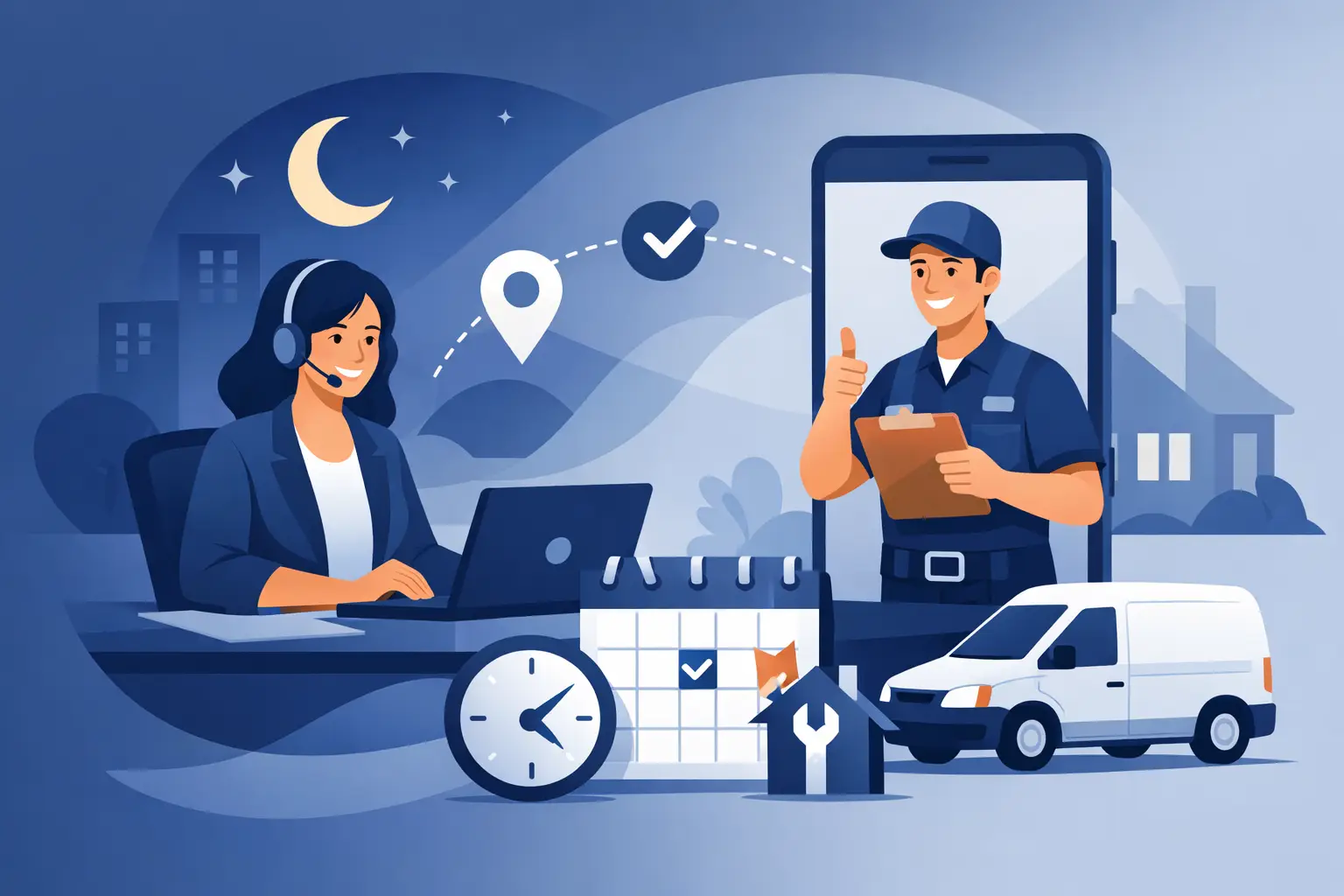
At 9:12 p.m., a homeowner with water spreading across a hardwood floor is not planning to leave three voicemails. They are calling the next restoration company that answers, understands the problem, and gives them a clear next step. For service businesses, an after hours answering service is not simply overflow coverage. It is the front door for revenue that arrives when the office is closed.
The difference is operational. A basic service takes a message for the morning. A revenue-focused system identifies whether the caller fits your service area and job criteria, handles the urgency correctly, and books an appointment or dispatch path that your team can actually fulfill. One produces a voicemail backlog. The other produces a qualified opportunity with a confirmed next action.
What an after hours answering service must do
Answering the phone is the minimum requirement. It is not the business outcome. The system has to move the conversation from first contact to a usable calendar entry without creating more cleanup work for the office.
For a restoration company, that might mean confirming the property address, identifying whether the loss is active, checking whether the property is residential or commercial, and determining whether the caller is authorized to make decisions. For a plumbing, HVAC, roofing, or home-services business, the qualification rules will be different. The point is not to force every caller through the same script. The point is to apply your rules consistently at 10 p.m. just as your best coordinator would at 10 a.m.
A capable after-hours workflow should also recognize that not every caller belongs on the schedule. A request outside your service area, a job type you do not perform, a vendor solicitation, or a price-shopping inquiry that fails your fit rules should not consume a valuable appointment slot. Screening protects your staff from unproductive follow-up and protects your crews from wasted truck rolls.
The workflow behind a booked appointment
An after-hours process works only when each handoff is defined. Here is what that looks like when it is built around real operations rather than a generic receptionist script.
1. The call is answered immediately
The caller reaches a voice agent or trained answering team without a ring cycle that ends in voicemail. The greeting identifies the business, gathers the reason for the call, and starts with the information that matters to the job.
Speed matters because callers with an urgent problem are often contacting multiple providers. Industry lead-response research consistently finds that response rates fall sharply as follow-up slows. After hours, the practical version of that finding is simple: the company that responds now has a chance to control the conversation.
2. The caller is qualified against your rules
Qualification should be specific. The workflow can ask for the ZIP code, service type, urgency, property type, insurance situation, decision-maker status, and any trade-specific details your team uses to decide whether to proceed.
That does not mean turning a distressed customer into an interrogation. Questions need to be ordered around the customer’s situation. An active water loss may require a fast escalation path. A non-urgent estimate request may be eligible for the next available inspection slot. A caller outside the coverage area can be directed appropriately instead of receiving a promise your team cannot keep.
3. A real slot is checked and held
This is where many answering services break down. They offer an appointment based on a static schedule, record a preferred time, or tell the caller that someone will confirm later. That is not a booked appointment.
A dependable system checks live availability before offering times. When the caller selects Tuesday at 10:00 a.m., that slot should be held while the booking is completed, then written to the correct calendar with the right job details. Calendar accuracy matters as much as call coverage. A double-booked estimator or a crew sent across the wrong service area is not a win.
4. Confirmation and follow-up happen automatically
The caller should receive a confirmation text with the appointment details and a clear way to reschedule or cancel. Your team should receive the call record, transcript, qualification notes, lead score, and scheduled appointment in the systems they already use.
By morning, the office should not need to reconstruct the conversation from a vague note that says, “Customer called about leak.” They should know who called, what happened, whether the lead met the rules, what was booked, and what needs escalation. A next-day confirmation message can further reduce preventable no-shows before a truck or representative is committed.
When a live person is necessary
AI voice agents and automation can cover a large share of after-hours inbound conversations, especially when the business has clear qualification and scheduling rules. But automation should not pretend every situation is routine.
A serious after-hours answering service needs escalation paths for active emergencies, upset callers, safety concerns, high-value commercial opportunities, and any situation where a human decision is required. The right question is not whether AI replaces people. It is whether the workflow gets each call to the right level of attention without making every after-hours inquiry wait for a person.
For some businesses, a blended model is the best fit: automated intake and scheduling for standard calls, with live escalation for defined scenarios. For others, an AI-first workflow is more practical because the office already has reliable on-call coverage once a qualified emergency is identified. The operating rules should decide the model, not a product demo.
The hidden cost of message-only coverage
A message-taking service can look inexpensive because the monthly line item is smaller than a managed appointment automation platform or overnight staff. That comparison misses the revenue side of the equation.
Suppose a qualified caller reaches voicemail at 9 p.m. and contacts two competitors before your office opens. Even if your team returns the call promptly at 8 a.m., the prospect may already have an appointment. The cost is not the missed message. It is the lost job, lost lifetime customer, and lost referral opportunity.
There is also an internal cost. Office staff spend mornings listening to recordings, calling back incomplete leads, checking calendars, correcting duplicate entries, and determining whether the request was ever a fit. That work compounds when weather events, seasonal demand, or advertising campaigns increase call volume.
The alternative is not to book every inquiry. It is to create a clean divide between qualified appointments, escalation cases, and leads that should be declined or routed elsewhere. A calendar full of low-probability estimates is not pipeline. It is overhead.
Questions to ask before choosing a provider
Before selecting an after-hours provider, test its operating model with your actual calls. Ask whether it can enforce service-area rules, trade-specific job criteria, and decision-maker requirements. Ask how it accesses live availability, whether it holds slots during booking, and what happens if two callers select the same time.
You should also ask what your morning team receives. A useful answer includes recordings or transcripts, disposition data, appointment details, escalation notes, and attribution information. “We send an email message” is not enough if your dispatch or sales process depends on accurate calendar and CRM records.
Finally, ask to hear or review real customer interactions where possible, not only polished scripted demonstrations. The test is whether the system can handle a hesitant homeowner, an unclear service request, an active emergency, or a caller who wants to reschedule. Reliability appears in the exceptions.
Build the rules before turning on the phones
The quality of an after-hours operation depends on the decisions you make before the first call arrives. Define what counts as a qualified lead, which jobs need immediate escalation, which areas you serve, who can receive an appointment, and which calendar slots are available for each type of work.
PsPro AI approaches this as inbound revenue operations, not as a generic virtual receptionist project. The intake playbook, qualification rules, calendar logic, text follow-up, and escalation routing all need to reflect how your business actually dispatches work and closes jobs.
Start with last month’s missed calls. Identify which callers should have been booked, which should have been escalated, and which should never have reached the schedule. That exercise gives you the rules an after-hours system needs to turn late-night demand into a confirmed, workable day for your team.